Landscape Drawing Sketch Tutorials
Landscape Drawing Sketch Tutorials: Mastering the Art of Nature's Depiction
Readers, have you ever wanted to capture the beauty of a landscape on paper, but felt overwhelmed by the task? It's a common feeling, but don't worry! Landscape drawing sketch tutorials can unlock your artistic potential. Mastering landscape sketching is a journey, not a race. With the right guidance and practice, you can create stunning works of art. I've spent years studying and teaching landscape drawing, analyzing effective techniques, and I'm here to share my expertise with you.
Unlocking the Secrets of Landscape Drawing Sketch Tutorials
This comprehensive guide dives deep into landscape drawing sketch tutorials, providing you with the knowledge and skills to transform your sketches from basic outlines into breathtaking masterpieces. We’ll cover everything from choosing the right materials to mastering essential techniques. Prepare to embark on a creative adventure!
Essential Materials for Landscape Sketching
Before we delve into techniques, let's gather the essential tools. Having the right materials makes a world of difference.
Choosing the Right Pencils
Pencils are your foundation. Experiment with different grades (H for hard, B for soft) to find your preferred level of darkness and control. A range from 2H to 4B is a solid start for landscape sketching. Harder pencils are ideal for light outlines and details, while softer pencils create darker, richer tones.
Consider investing in a quality sketching pencil set to explore different shading options. Experimentation helps you find your preferred technique and style.
Sharpening your pencils correctly is crucial for precise work. A sharp point allows for fine details, while a broader point is best for creating larger areas of shading.
Selecting the Perfect Paper
The paper you choose significantly impacts your drawing's final look and feel. Consider factors like texture, weight, and size when selecting your paper.
Thicker paper is less likely to wrinkle or tear, while textured paper can add depth and character to your sketches. Experiment with different types and weights to discover your preferences.
The size of your paper will affect the scale of your landscape drawing. Larger papers allow for more detail and grandeur, smaller sizes are great for quick studies and practice.
Other Useful Tools
Beyond pencils and paper, several other tools can enhance your landscape drawing. An eraser is essential for correcting mistakes and refining details.
A kneaded eraser is incredibly versatile, allowing you to lift small amounts of graphite or blend tones. A sturdy vinyl eraser is great for cleaning up larger areas.
Blending stumps or tortillons help soften pencil marks, creating smooth transitions between light and dark areas. Consider these tools to refine your shading style.
Mastering Basic Sketching Techniques for Landscapes
With your materials ready, let's explore fundamental techniques for beginners.
Perspective and Composition
Understanding perspective is crucial for creating realistic landscapes. One-point perspective involves using a single vanishing point on the horizon line.
Two-point perspective uses two vanishing points, adding depth and complexity to your scenes. Experiment with different vanishing points to create a visually engaging landscape.
Composition is how you arrange elements in your drawing. The rule of thirds is a helpful guideline, dividing your paper into thirds both horizontally and vertically.
Shading and Value
Shading adds depth and realism to your drawings. Start by identifying your light source and placing your darkest shadows where light doesn’t reach.
Gradually transition from dark to light using different pencil grades or blending techniques. Varying the pressure of your pencil is another way to create shades.
Practice creating smooth gradients and sharp contrasts between light and shadow. This will add depth and realism to your artwork.
Texture and Detail
Adding texture to your drawings brings them to life. Experiment with different pencil strokes to create the illusion of rough surfaces.
Use cross-hatching, stippling, and scumbling to create distinct textures. These are key techniques for imitating various surfaces in your drawings.
Observe the textures in nature closely, paying attention to how light and shadow interact. This observation will inform your artistic choices.
Advanced Techniques for Landscape Drawing Sketch Tutorials
Once you master the basics, explore more advanced techniques to enhance your skills.
Working with Different Media
Experiment with different media, such as charcoal, pastels, or colored pencils, to expand your creative possibilities. Each medium offers unique textures and effects.
Charcoal creates rich, dark tones, while pastels offer vibrant colors. Colored pencils allow for delicate detail work.
Combine different media for interesting textures and effects. Layering charcoal with pastel, for example, can create unexpected results.
Understanding Light and Shadow
Mastering light and shadow is key to creating realistic landscapes. Observe how light falls on different objects and surfaces.
Pay attention to the direction, intensity, and color of the light. This knowledge will inform your shading choices.
Practice depicting different types of lighting, such as soft, diffused light or harsh, direct sunlight. This will add visual interest.
Adding Atmospheric Perspective
Atmospheric perspective creates depth and realism by depicting objects in the distance as fainter and less detailed. This is a crucial aspect of landscape sketching.
Use lighter values and less detail for distant objects, while using darker values and more detail for closer objects. Experiment and observe nature.
Atmospheric perspective gives a sense of vastness and distance, enhancing visual storytelling in your landscape drawings.
Landscape Drawing Sketch Tutorials: Step-by-Step Guide
Let's walk through a simple landscape drawing step by step.
Step 1: Basic Outline
Start with a light outline of the main elements—horizon line, mountains, trees, etc. Keep it loose and don’t worry about perfection.
Use light pencil strokes to establish the basic composition. This initial sketch is a blueprint for the final piece.
Focus on establishing the overall shape and placement of your subject matter. This initial sketch provides a framework for your drawing.
Step 2: Adding Details
Gradually add more details to your drawing, focusing on important features. Refine shapes, add texture, and begin shading.
Pay attention to proportions and relationships between different elements. Ensure everything is in scale and well-proportioned.
Start adding subtle details and texture to your drawing. This process brings the landscape to life.
Step 3: Shading and Blending
Use shading and blending techniques to add depth and dimension. Layer different shades of pencil to achieve a smooth transition.
Use blending stumps or your fingers to blend the pencil strokes. Observe the natural light and shadow.
Refine your shading to highlight features and enhance the depth and realism of your landscape.
Step 4: Final Touches
Once you’re happy with the shading, add final touches to enhance the overall effect. Refine details, adjust values, and erasing as needed.
Step back and assess your work from a distance. Look for areas that need improvement or refinements.
Adding final touches can elevate your landscape from good to exceptional. Don't rush this critical step.
Different Styles of Landscape Sketching
Explore various styles to find your unique voice.
Realistic Landscape Sketching
Aims for precise detail and accuracy. This style focuses on capturing the scene precisely as seen.
Techniques include detailed shading, perspective, and accurate depiction of light and shadow. This style requires careful observation.
Practice observing nature accurately and translating those details onto your paper. Patience and meticulousness are key.
Impressionistic Landscape Sketching
Emphasizes capturing the mood and atmosphere rather than minute details. Loose brushstrokes and expressive lines create a sense of movement.
This style emphasizes capturing the essence of the scene rather than creating a photorealistic representation. Experiment with different levels of abstraction.
Impressionistic sketching prioritizes capturing feeling, emotion, and atmosphere over literal representation.
Abstract Landscape Sketching
Focuses on simplified forms and bold colors, expressing the essence of the landscape in a non-representational way. This style allows creative freedom.
Abstract landscape sketching often avoids depicting specific objects or recognizable features. Experiment with shapes, colors, and textures.
This style can be deeply personal and expressive, allowing artists to convey their unique perspectives.
Troubleshooting Common Landscape Sketching Challenges
Addressing common hurdles in your creative journey.
Difficulty with Perspective
Practice drawing simple shapes in perspective to build your understanding. Use guidelines and vanishing points to guide your sketching.
Start with simple scenes before tackling more complex landscapes. Begin with basic forms and gradually add complexity.
Work from photos or real-life references to study perspective in detail. Direct observation is crucial for improvement.
Problems with Shading
Pay close attention to your light source and observe how shadows fall. Experiment with different shading techniques.
Practice value scales to understand how light and dark tones interact. Use reference photos to help guide your shading.
Use blending techniques to create smooth transitions between values. Blending stumps or fingers can enhance the look.
Lack of Detail
Start with basic shapes and gradually add details. Observe your subject matter closely, noting subtle changes in texture and shape.
Use different pencil grades for detailed work. Sharpen your pencils frequently for crisp lines.
Practice sketching individual elements like trees, rocks, and plants before working on a complete landscape.
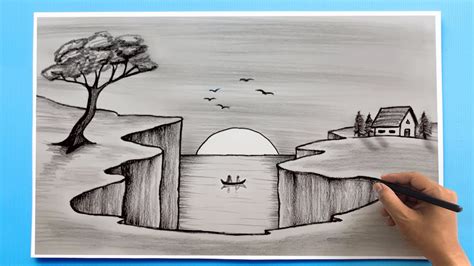
Here are some valuable tricks to improve your landscape sketching skills.
Start Simple
Begin with straightforward compositions before moving onto more complex scenes. Practice and mastering the basics is key to progress.
Work from simple shapes, then add details gradually. This step-by-step approach avoids overwhelming you.
Simple exercises like drawing basic shapes in perspective are great for practicing fundamental skills.
Use References
Work from photographs or real-life observations, paying close attention to detail. Using references helps build your observational skills.
Explore different sources of inspiration, such as nature photography books or online resources. Study different artists.
Analyze the composition, light, and shadow in the reference images and try to replicate those elements in your sketches.
Practice Regularly
Consistent practice is crucial for improving your skills. Set aside time each day, or at least a few times a week, to sketch.
Create a dedicated space for sketching. Inspiration may strike at unexpected times, so be ready to take notes.
Join online sketching groups or take classes to get feedback and learn from others. Social interaction boosts motivation.
Frequently Asked Questions about Landscape Drawing Sketch Tutorials
What are the best pencils for landscape sketching?
A range of pencils from 2H to 4B is a good starting point. Harder pencils (H) are best for light outlines, while softer pencils (B) create darker tones.
How do I improve my perspective skills?
Practice drawing simple shapes in perspective, starting with one-point and then two-point perspectives. Use reference photos and study how objects recede into the distance.
How can I add more realism to my landscape sketches?
Focus on light and shadow, using shading and blending techniques to create depth. Pay close attention to detail, adding textures and subtle variations in tone.
Conclusion
In conclusion, landscape drawing sketch tutorials offer a fantastic journey into artistic expression. Through practice and understanding, you can bring the beauty of nature to life on paper. Remember, the key is consistent practice and experimentation. So, grab your pencils, find your inspiration, and start creating! And, be sure to check out our other articles for more helpful tips and tutorials on various art techniques!


